

Two pages cover the same subject. One opens with a story about why the founders started the company. The other opens with three sentences that answer the question in the title. Both are well written, both rank on page one, and only one of them gets quoted in AI answers. The difference is not quality; it is extractability, and an AI readiness score measures exactly that difference as a number between zero and a hundred.
On this page
How an Answer Engine Picks a Passage
A model answering a question does not read your page the way a visitor does. It fetches the HTML, often without running JavaScript, scans for a passage that stands alone as an answer, checks whether the page identifies itself clearly, and looks for signals that the content is current and structured. The whole process is measured in milliseconds, and it is unforgiving of pages that take their time.
That process can be scored, because every one of those checks leaves evidence in the HTML. A title tag exists, or it does not. A date is machine-readable, or it is only printed on screen. A paragraph near the top either answers something or it does not. None of this requires guessing what a model thinks.
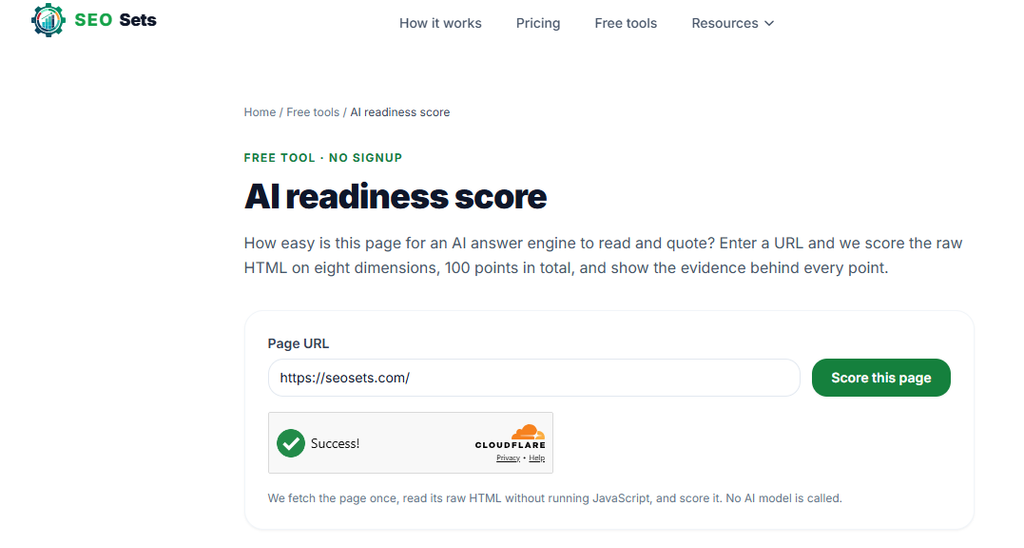
The scoring method is deliberately plain, and the note under the form says so: the page is fetched once, the raw HTML is read without executing JavaScript, and the result is produced by rules rather than by a language model. Two consequences follow. Content that only appears after rendering is judged absent, which is exactly how some crawlers see it. And the same URL scored twice returns the same number unless the page itself changed, which makes the score usable as a before-and-after measure rather than a mood reading.
Note also that a page URL is required rather than a domain. Scores are page-level, because templates differ across a site and a strong homepage says nothing about a weak blog template.
Breaking Down a Live Page Score
Free tool: see which AI crawlers can read your site, and which are blocked. Run the AI crawler check
A score arrives within seconds of submitting the URL, with the headline number first.
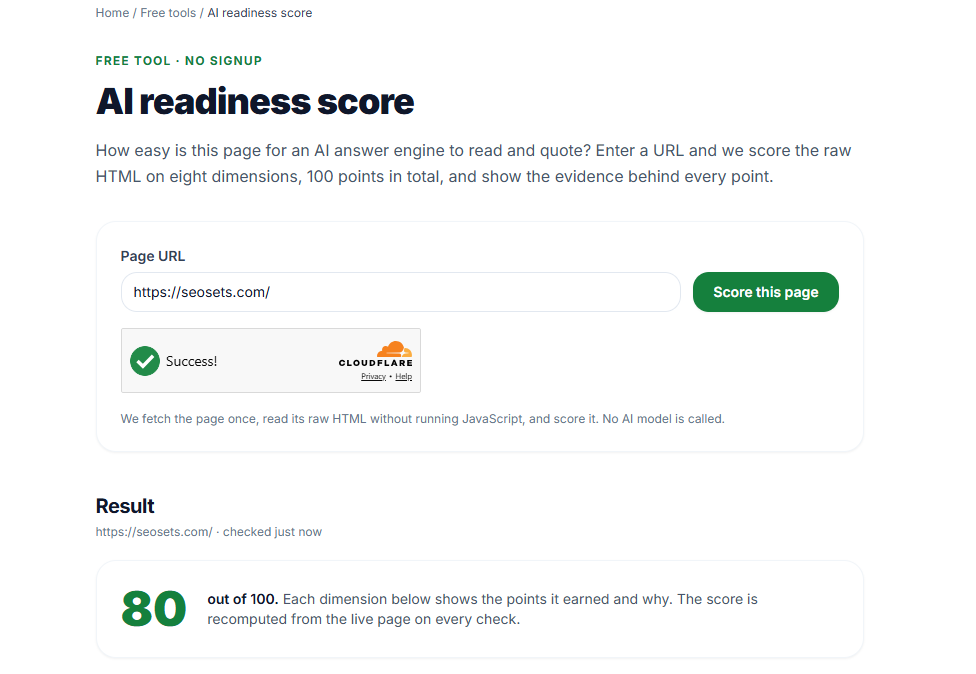
Eighty out of a hundred is a useful result to study because the missing twenty points are spread across three dimensions rather than concentrated in one broken thing. Pages in the nineties are uncommon, and hunting a perfect hundred rarely repays the hours. What matters is knowing precisely which signals are missing and what each one would cost to add.
The breakdown underneath is where the work gets defined, since every line carries both the points earned and the evidence behind them.
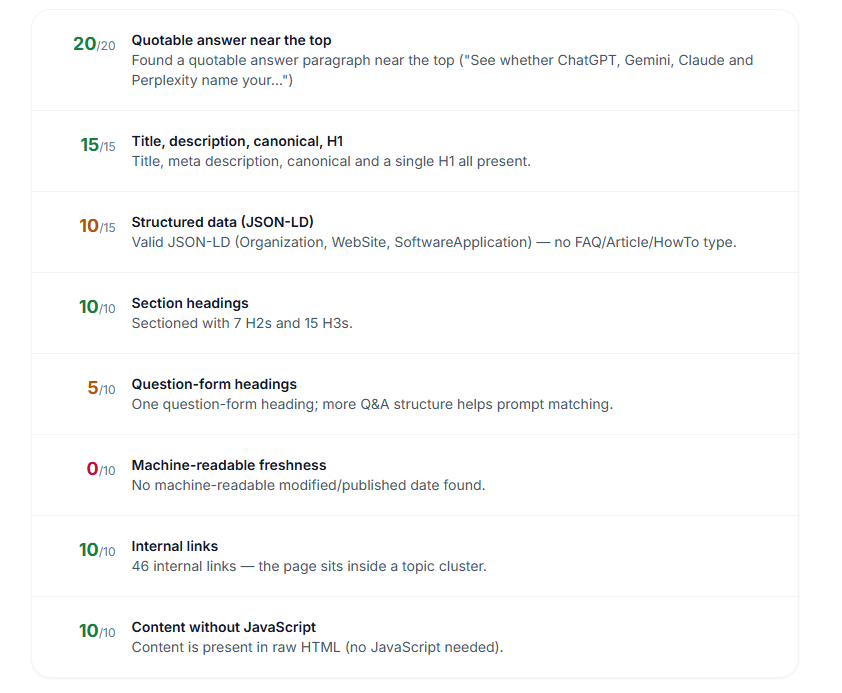
Three deductions appear in this run, and each represents a different class of fix.
Structured data scored ten of fifteen. Valid JSON-LD was found for Organization, WebSite and SoftwareApplication, with no Article, FAQPage or HowTo type present. Identity schema tells a model who published the page. Content schema tells it what the page actually says, and only the second kind supports extraction.
Question-form headings scored five of ten, with a single question heading detected. People ask assistants whole questions, so headings written as those questions create direct matches between prompt and section. Rewriting three or four existing headings usually recovers the points without touching body copy.
Machine-readable freshness scored zero because no published or modified date could be parsed. A date printed in visible text does not count. This is the cheapest line on the whole report to fix and often the most valuable, since recency breaks ties between otherwise comparable sources.
Everything else held full marks: seven H2s and fifteen H3s for sectioning, forty-six internal links placing the page inside a topic cluster, content present in raw HTML, and the full set of title, description, canonical and single H1.
The Scoring Model in Plain Terms
A hundred points split across eight dimensions, weighted by how much each one affects whether a passage can be lifted and attributed.
| Dimension | Points | Why it carries that weight |
| Quotable answer near the top | 20 | Extraction is the whole mechanism, so this is the heaviest signal |
| Title, description, canonical, H1 | 15 | Identity signals that tell a model what the page is and which URL owns it |
| Structured data (JSON-LD) | 15 | Content types describe what the page says, not just who published it |
| Section headings | 10 | Real sectioning lets a model locate the relevant part |
| Question-form headings | 10 | Headings phrased as queries create direct prompt matches |
| Machine-readable freshness | 10 | Recency decides between two otherwise equal sources |
| Internal links | 10 | Evidence that the page belongs to a wider topic cluster |
| Content without JavaScript | 10 | Text absent from raw HTML may never be seen at all |
Twenty points on a single opening paragraph looks lopsided until you watch how answers get built. Models take the clearest candidate passage available. Give them nothing clean to take and the other nine checks stop mattering.
Three Habits That Cost Most Pages Points
Writing openings for atmosphere rather than for answers
Marketing copy is trained to build interest before delivering substance, and extraction rewards the opposite order. A passage beginning with “it” or “this approach” cannot stand alone, so even a strong paragraph becomes unquotable once separated from what came before.
Treating schema as a box to tick
Many sites carry publisher markup and stop, leaving a page that announces who made it while saying nothing structured about its own subject.
Leaving dates invisible to parsers
A visible date reads fine to a person and registers as nothing to a machine, which hands the recency advantage to any rival that marked theirs up properly.
A Routine That Fits in a Week
Start with one commercially important page rather than a random post. Run it through the AI Readiness Score checker and note the three largest deductions.
Fix the date first, since adding dateModified to a template lifts every page at once. Rewrite the opening next, into two or three self-contained sentences that answer the page’s core question above any brand framing. Then add the matching content schema type and convert a few headings into real questions. Rescore at the end of the week and keep both numbers together, because template-level problems repeat across hundreds of URLs and one fix usually shows up site-wide.
Frequently Asked Questions
Does this score affect Google rankings?
No. It measures how readable and quotable a page is for answer engines, which is a separate question from ranking, though clean structure helps both.
Can a page score well and still never be cited?
Yes. Readiness is necessary rather than sufficient. If crawlers cannot reach the page, or a stronger source already owns the topic, a high score alone will not produce citations.
Should every page be optimised this way?
Focus on pages that answer questions buyers ask. Thin utility pages and single-action landing pages have little to extract and little to gain.
The Takeaway
Visibility in AI search runs in sequence: a bot reaches the page, a parser understands it, and a model finds something worth quoting. The middle step is the one you control most directly and measure least often, which is why a readiness number earns its place even when imperfect.
Tools like SEOsets.com can help assess website readiness and identify areas that may need improvement for better search visibility. Pick the page you would most want an assistant to quote, score it before changing anything, fix the largest deduction this week, then score it again and watch whether the number moves. Structural edits compound across a site, and the work helps human readers too, since a page that answers its own question in the first paragraph was always the better page.
Free, no signup
Is your site blocking the AI crawlers that cite you?
The free AI crawler check reads your robots.txt and requests your page as GPTBot, ClaudeBot, PerplexityBot and the other AI crawlers, so you can see who gets in and who gets blocked.
Run the free checkSee all free tools
Vinod Jethwani is the CEO of Walnut Solutions, a leading SEO company renowned for its data-driven strategies and customized solutions. With extensive expertise in digital marketing and a results-oriented approach, Vinod has helped businesses across diverse industries enhance their online presence and achieve sustainable growth. As a trusted advisor and innovator, he is committed to driving measurable success for his clients in the competitive digital landscape. How we measure