

Robots.txt has quietly changed function. For twenty years, it was a traffic management file, used to keep search engines out of admin directories and duplicate URLs. It now carries a commercial decision as well: which AI systems may read your content, and for what purpose. An AI robots.txt generator exists because that decision has become too granular to make by hand, with each major provider running three separate user agents whose names reveal nothing about what blocking them would cost.
The practical problem is asymmetry of information. A site owner reading a list of user agent strings cannot tell that one controls citation in ChatGPT answers while another controls inclusion in training data. Published documentation covers it, spread across several vendor help pages that change without notice. A generator that labels each agent by function collapses that research into a decision you can make in a minute.
How the Crawlers Are Classified
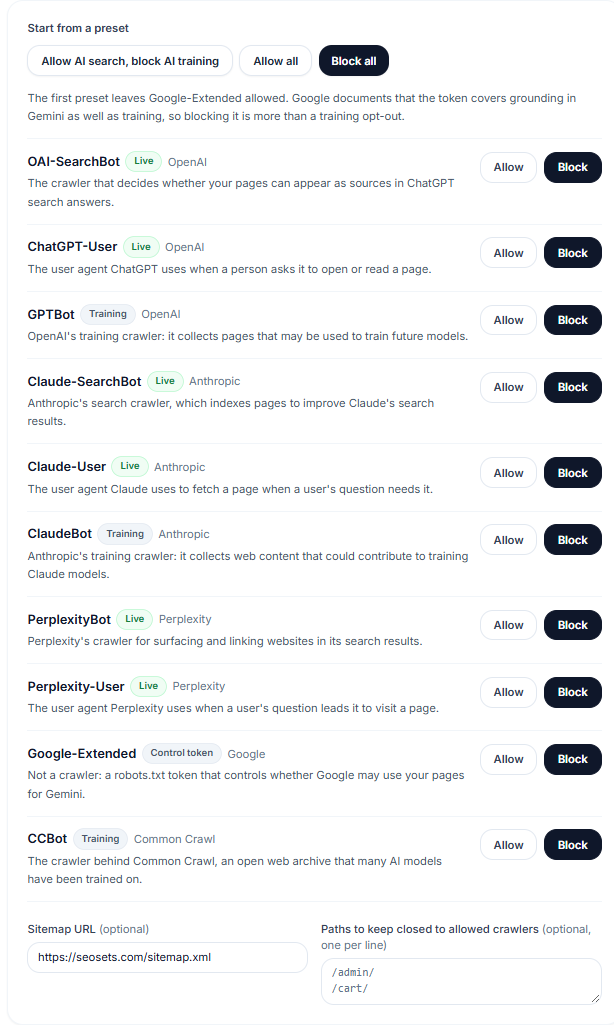
Three categories appear throughout the tool, and the distinction is the foundation for everything else.
Live crawlers fetch pages so an assistant can answer a question now. OAI-SearchBot, Claude-SearchBot and PerplexityBot handle search indexing for their platforms, while ChatGPT-User, Claude-User and Perplexity-User retrieve specific pages when a person’s question requires it. These are the agents attached to citations and referral traffic.
Training crawlers collect content that may contribute to future models. GPTBot, ClaudeBot and CCBot fall here. Common Crawl deserves particular attention, since its archives have been used to train a wide range of models rather than any single vendor’s.
Control tokens are different again. Google-Extended is not a crawler at all. No request ever arrives bearing that name. It is a directive Google reads to determine whether content it has already crawled may be used for Gemini training and for grounding answers in Gemini Apps and on Vertex AI. Blocking it therefore reaches further than a training opt-out, which is why the tool leaves it allowed in its first preset and says so explicitly.
Configuration One: Allow AI Search, Block AI Training
This configuration represents the position most publishers arrive at after working through the trade-offs: remain available to the systems that cite sources, withhold content from the systems that absorb it.
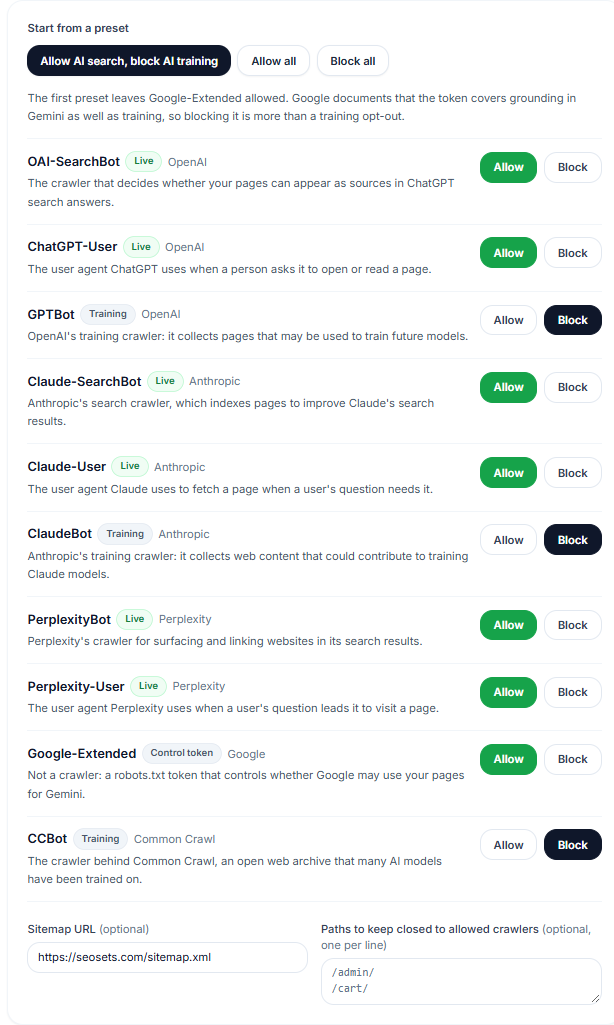
Reading the toggle states against the labels shows the logic. Every agent tagged Live sits on Allow. Every agent tagged Training sits on Block. Google-Extended, the control token, remains allowed for the reason given in the note above the list. The individual toggles remain available after a preset is applied, so a publisher with a specific concern about one vendor can depart from the pattern without rebuilding the file.
The generated output separates the two groups into labelled blocks.
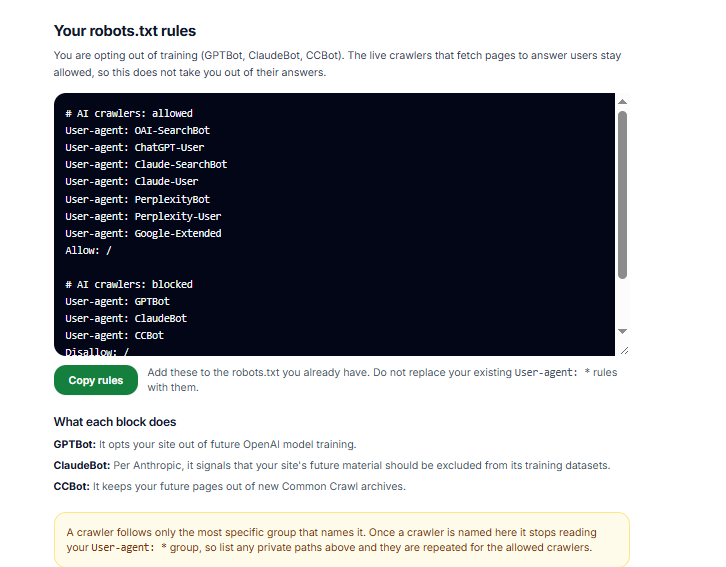
Structurally, the file lists all allowed agents under a shared Allow directive and all blocked agents under a shared Disallow directive. Grouping several user agent lines before a single rule is valid robots.txt syntax and keeps the file readable, which matters when a colleague inherits it a year from now.
The notes beneath the output translate each block into its consequence. Blocking GPTBot opts the site out of future OpenAI model training. Blocking ClaudeBot signals, in Anthropic’s own framing, that future material should be excluded from its training datasets. Blocking CCBot keeps future pages out of new Common Crawl archives. The word future carries weight in all three. These directives govern collection from this point forward and do not retrieve content already gathered.
Configuration Two: Unrestricted Access
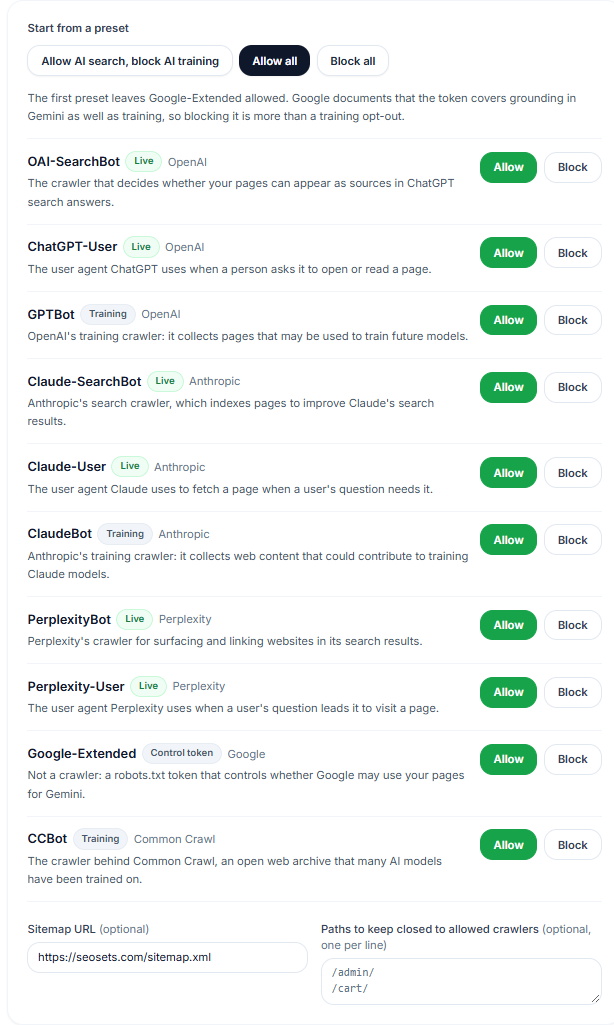
Here every agent sits on Allow, training included. The resulting file is correspondingly compact.
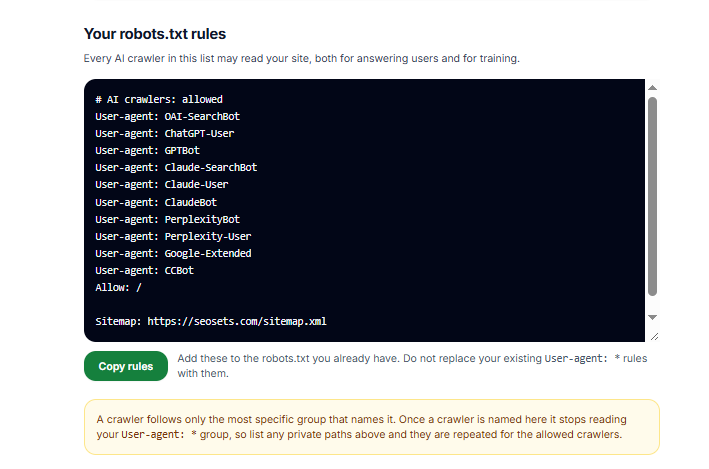
Two configuration fields apply regardless of which position you take, and both appear in the output. The sitemap directive points crawlers at your full URL set rather than leaving discovery to internal linking, which is particularly useful for large sites where deep pages are several clicks from the homepage. The paths field holds directories that should remain closed even to allowed crawlers, with admin and cart routes as the common examples. That second field exists to solve a precedence problem described below, and skipping it is the most frequent way a hand-written AI robots.txt file ends up exposing more than intended. The AI robots.txt generator carries both fields through into every configuration it produces.
Configuration Three: Full Exclusion
The output states the cost before showing the file: six live crawlers blocked, with the consequence that those products will read and cite the site less often.
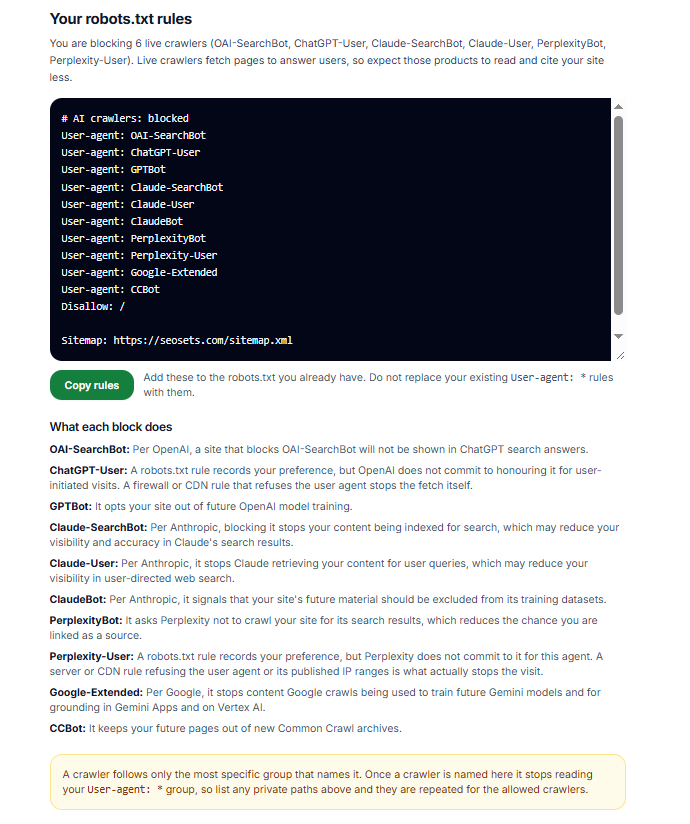
The per-agent analysis beneath this configuration is the most instructive section in the tool, because it draws distinctions that vendor documentation states but rarely emphasises.
Blocking OAI-SearchBot removes the site from ChatGPT search answers, per OpenAI. Blocking Claude-SearchBot prevents indexing for search, which Anthropic notes may reduce both visibility and accuracy in Claude’s results, while blocking Claude-User stops retrieval in response to user questions entirely. PerplexityBot governs whether the site can be linked as a source in Perplexity results.
Two entries carry a caveat that changes how the file should be understood. For ChatGPT-User and Perplexity-User, a robots.txt rule records a stated preference, but neither provider commits to honouring it for user-initiated visits. Enforcement in those cases comes from a server or CDN rule refusing the user agent or its published IP ranges. The directive remains worth writing as a record of intent, provided nobody mistakes it for a technical control.
| Configuration | Training crawlers | Live crawlers | Appropriate when |
| Allow AI search, block AI training | Blocked | Allowed | Citations carry value and content should stay out of training sets |
| Allow all | Allowed | Allowed | Reach is the priority and content carries no licensing constraint |
| Block all | Blocked | Blocked | Content is paywalled, licensed, or exposure carries measurable cost |
Group Precedence, and Why Hand-Written Files Fail
Robots.txt matching follows a specificity rule that catches out experienced practitioners. A crawler obeys only the single most specific group that names it, and ignores every other group in the file, including the general group addressed to all agents.
The consequence is direct. A site that has spent years maintaining disallow rules for admin, checkout, and internal search paths under its general group loses all of that protection for any agent it subsequently names. Add a line allowing OAI-SearchBot, and that agent stops reading the general group entirely, which means the paths you believed were closed are now open to it.
This is why the generator asks for private paths separately and repeats them inside each allowed agent’s group, and why the copy instruction states that the rules should be added to an existing file rather than replacing it. Scope matters too: directives apply per host, so each subdomain requires its own file. Documentation, help centre, and shop subdomains are frequently the pages assistants most want, and are frequently the ones nobody has configured.
Frequently Asked Questions
Does blocking a training crawler remove content from models already trained?
No. Directives govern future collection. Content already gathered remains in existing datasets.
How long before a change takes effect?
Fetch behaviour responds quickly. Search inclusion on some platforms can take around a day to reflect an updated file.
Should robots.txt be the only control?
No. For user-initiated agents and for any crawler that ignores the standard, enforcement belongs at the server or CDN layer. Robots.txt states the policy, infrastructure applies it.
Conclusion
The question is no longer whether to permit AI crawlers, but which of two functions to support: answering questions asked today, and training the systems that will answer them next year. Those functions run on separate user agents, and a file that fails to distinguish them either forfeits citations unnecessarily or contributes content its owner never intended to supply.
Tools like SEOsets.com can help simplify AI crawler management by providing insights and resources for configuring crawler access. Choose the configuration that matches your position on that question, append the generated rules to your existing file rather than overwriting it, and list your private paths so they survive the shift in precedence. Then verify the result with a crawler access test, since a correctly written directive still has to survive whatever bot protection sits in front of your origin.
Free, no signup
Is your site blocking the AI crawlers that cite you?
The free AI crawler check reads your robots.txt and requests your page as GPTBot, ClaudeBot, PerplexityBot and the other AI crawlers, so you can see who gets in and who gets blocked.
Run the free checkSee all free tools
Vinod Jethwani is the CEO of Walnut Solutions, a leading SEO company renowned for its data-driven strategies and customized solutions. With extensive expertise in digital marketing and a results-oriented approach, Vinod has helped businesses across diverse industries enhance their online presence and achieve sustainable growth. As a trusted advisor and innovator, he is committed to driving measurable success for his clients in the competitive digital landscape. How we measure